Energy & Electricity
How to Find What's Using the Most Electricity in Your Home
Find which appliances use the most electricity at home with safe plug-in measurements, kWh calculations, and a practical seven-day tracking plan.
Quick answer
To find what uses the most electricity in your home, check your bill for total kWh, list likely high-use equipment, measure suitable plug-in appliances with a properly rated energy monitor, and compare kWh over representative periods. Use utility or professional data for hardwired loads. Rank devices by total energy used, not peak watts.
Start With Your Electricity Bill, Not a Guess
Your electric bill usually reports energy consumption in kilowatt-hours (kWh). A watt describes how quickly a device uses power; a kilowatt-hour measures how much energy it uses over time. A device that draws 1,000 watts for one hour uses 1 kWh. That difference matters: a high-wattage appliance used briefly may consume less electricity than a smaller load running for many hours.
- Find the total kWh for your most recent billing period. Do not confuse it with the dollar amount due.
- Record the billing dates and number of days. Compare similar-length periods when possible.
- If your utility offers an hourly or daily usage graph, look for sustained overnight loads and peaks during heating, cooling, cooking, or laundry.
- Write down your electricity rate or the applicable energy charge from your bill. Time-of-use rates, tiers, fees, and taxes may make the final bill different from a simple kWh estimate.
A utility usage graph shows whole-home consumption, not necessarily which appliance caused it. Treat a sudden peak as a clue to investigate rather than proof about one device.
Make a Shortlist of Likely Electricity Users
Begin with equipment that draws substantial power, operates for long periods, or both. The largest electricity user depends on your climate, fuel choices, equipment efficiency, household size, and habits. A home with electric resistance heat can have a very different profile from one heated by natural gas.
- Heating and cooling: central air conditioning, heat pumps, electric resistance heaters, and window AC units.
- Water heating: an electric storage water heater or heat-pump water heater, if your home has one.
- Laundry and kitchen: electric clothes dryers, ovens, cooktops, and dishwashers with heated drying.
- Always-on equipment: refrigerators, freezers, dehumidifiers, aquariums, networking gear, and some entertainment systems.
- Seasonal or unusual loads: pool pumps, portable heaters, EV charging, and equipment added recently.
Measure Plug-In Devices With an Electricity Usage Monitor
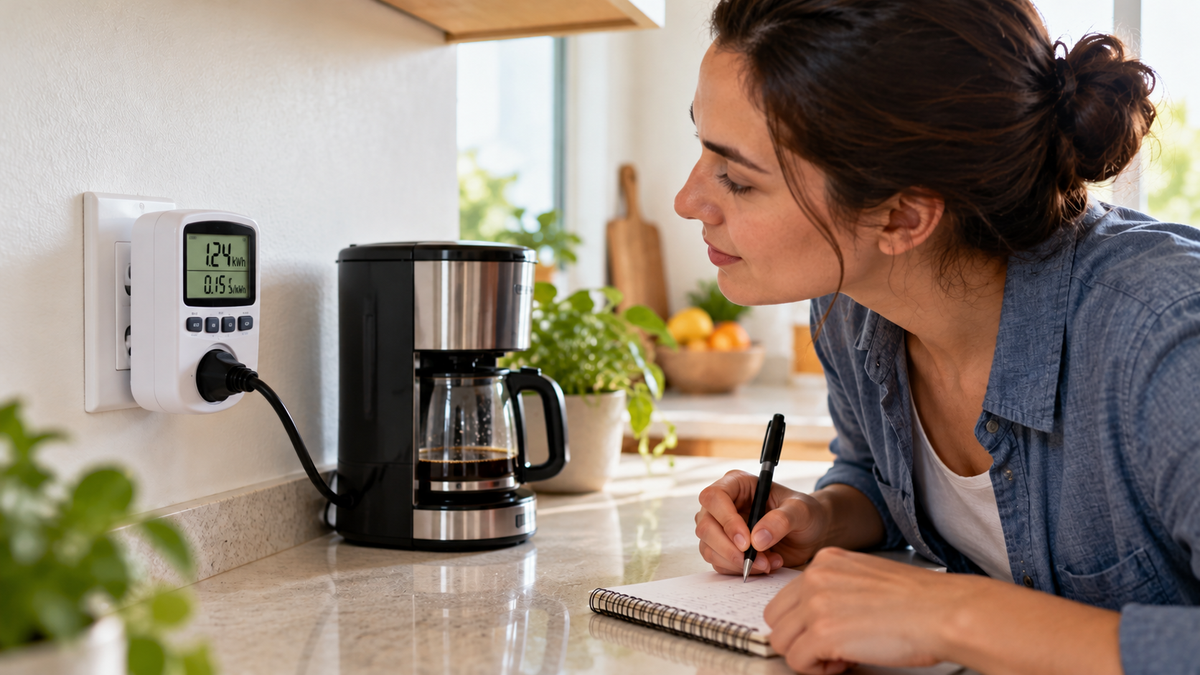
A plug-in electricity usage monitor, sometimes called a watt meter, sits between a compatible appliance plug and a wall outlet. Models that track accumulated kWh are more useful for this task than models showing only instantaneous watts. Select a monitor rated for the appliance voltage and load, and follow both manufacturers’ instructions.
- Choose a suitable plug-in appliance, such as a desktop computer, television, or refrigerator, only if the monitor is rated for it and the manufacturer permits that setup.
- Plug the monitor directly into an appropriate wall receptacle as instructed. Avoid improvised adapters or overloaded extension cords.
- Reset its accumulated kWh reading and note the start time.
- Measure a complete, representative period: several hours for steady electronics and at least a full day, often longer, for cycling appliances.
- Record kWh, elapsed time, and the appliance’s normal usage pattern. Repeat if the first period was unusual.
Why a Single Watt Reading Can Mislead You
A refrigerator may show a higher reading while its compressor runs and a much lower reading when it cycles off. A portable heater may draw high power but only while its thermostat calls for heat. Compare accumulated kWh over a realistic interval, not just one snapshot.
Calculate Monthly kWh and Running Cost
For a device with fairly constant power draw, estimate monthly energy use with this formula: watts × hours per day × days used ÷ 1,000 = monthly kWh. Then multiply kWh by your applicable electricity price per kWh for an approximate energy cost.
| Illustrative input | Value |
|---|---|
| Power draw | 1,500 watts |
| Use per day | 2 hours |
| Days used | 30 |
| Estimated energy | 90 kWh |
| Illustrative energy rate | $0.18 per kWh |
| Estimated energy charge | $16.20 |
Calculation: (1,500 × 2 × 30) ÷ 1,000 = 90 kWh. At an assumed $0.18/kWh, 90 × $0.18 = $16.20. This is an example, not a measured appliance result or a claim about average U.S. electricity prices.
To calculate costs using your own wattage, hours, and electricity rate, try Nestlyra’s Appliance Energy Cost Calculator. For appliances that cycle on and off, use measured kWh when possible rather than assuming the nameplate wattage applies continuously.
If a monitor reports 3.2 kWh over two representative days, the daily average is 1.6 kWh. A rough 30-day projection is 48 kWh. Multiply by your own rate to estimate the energy portion of the cost. Actual monthly use can change with weather, schedules, and operating conditions.
Check Large or Hardwired Equipment Safely
Central HVAC systems, electric water heaters, ovens, dryers, and EV chargers may be hardwired or use plugs incompatible with ordinary consumer monitors. Do not force a plug-in test. Instead, look for energy reporting in the equipment’s own app, a utility-provided energy dashboard, or a qualified home energy assessment.
For a rough estimate of air-conditioning electricity costs, use Nestlyra’s AC Running Cost Calculator. This is a planning estimate, not a direct measurement of a central system; actual consumption varies with equipment, weather, and runtime.
- Review your utility’s daily or hourly usage history and compare days with similar weather and household activity.
- Use manufacturer-provided energy reports when available, while recognizing that some show estimates rather than direct measurements.
- For heating and cooling, note outdoor temperatures, thermostat settings, and runtime.
- For suspiciously high or unexplained loads, ask a licensed electrician or qualified energy auditor about safe circuit-level measurements.
Keep a Simple Seven-Day Electricity Log
A short log turns guesses into comparable observations. Record your whole-home kWh when your utility provides daily data, plus individual monitor readings for selected plug-in devices. Note changes in temperature, visitors, laundry, cooking, and equipment schedules.
| Item | What to record | Why it helps |
|---|---|---|
| Whole home | Daily kWh and date | Shows overall trend |
| Plug-in device | Measured kWh and test duration | Compares individual loads |
| HVAC | Runtime, settings, outdoor conditions | Explains weather-related variation |
| Household activity | Laundry, cooking, guests, charging | Adds context to peaks |
Do not add together measurements from overlapping periods and assume they equal the utility bill. Some large loads may not be individually monitored, and billing dates or meter intervals may differ. The log is a way to prioritize follow-up checks, not a complete electrical audit.
Decide What to Fix First
Rank potential improvements by estimated monthly kWh, not just the device’s peak wattage. Start with practical, low-risk changes: correcting unnecessary operating hours, using appropriate power-management settings, checking thermostat schedules, and maintaining equipment according to manufacturer instructions. Do not replace a working appliance based on a single reading.
- Identify the largest measured or strongly suspected monthly kWh users.
- Check whether their operating hours are necessary or can be reduced safely.
- Estimate the possible reduction in kWh before spending money.
- Make one change at a time and compare similar periods afterward.
- If usage remains unexpectedly high, request a professional assessment rather than attempting electrical repairs yourself.
Frequently Asked Questions
What uses the most electricity in a house?
There is no single answer for every house. Heating and cooling, water heating, and other high-power or long-running equipment are sensible places to investigate, but your largest user depends on the equipment and how you use it. Compare kWh over time to find out.
Can a smart meter tell me which appliance uses electricity?
Most utility smart-meter views show whole-home usage by time interval. Some advanced services offer device-level estimates, but ordinary interval data does not reliably identify every appliance on its own.
How long should I monitor an appliance?
For a steady load, several hours may be enough for an initial estimate. For cycling or irregular appliances, measure at least a full typical day and preferably multiple representative days. Record the duration with the kWh result.
Is a high wattage rating the same as high electricity use?
No. Wattage is the rate of power use; kWh includes time. A high-wattage device used for minutes may consume less total energy than a lower-wattage device running continuously.
Can I measure a central air conditioner with a plug-in watt meter?
Not with a standard household plug-in monitor. Central systems are commonly hardwired and may operate at voltages and currents outside that monitor’s rating. Use utility or equipment data, or ask a qualified professional.