Energy & Electricity
Electric Bill High but Usage Is the Same
If your electric bill increased even though your kWh usage stayed about the same, compare electricity rates, billing days, fixed and delivery charges, time-of-use pricing, credits, adjustments, and meter information.
Quick answer
If your electric bill is higher but your electricity usage in kilowatt-hours (kWh) is about the same, the increase may be coming from something other than total consumption. Compare the electricity rate, number of billing days, fixed and delivery charges, taxes and fees, credits or adjustments, rate plan, and meter-reading information on the current and previous bills. If you are on time-of-use or another variable rate, when you used electricity may also affect the cost even when total kWh is similar.
The same kWh does not always mean the same bill
Kilowatt-hours measure how much electrical energy you used, but your final bill may contain more than a simple kWh total multiplied by one unchanging price. Depending on your utility and rate plan, the bill may include energy charges, fixed charges, delivery or distribution charges, taxes, fees, credits, adjustments, or prices that vary by season or time of use.
That means two billing periods with similar total kWh can still produce different dollar amounts.
| If this stayed similar | Check this next |
|---|---|
| Total kWh | Electricity rate and other per-kWh charges |
| Total kWh | Fixed, delivery, distribution, or service charges |
| Total kWh | Billing period length |
| Total kWh | Credits, adjustments, taxes, and fees |
| Total kWh on a time-of-use plan | When the electricity was consumed |
Check whether the electricity rate changed
A higher price per kilowatt-hour can raise your bill even when your electricity consumption barely changes. Electricity prices vary by location, utility, supplier, rate schedule, and other factors.
Look for the rate or energy-charge information on both bills. Some bills show a single per-kWh figure, while others separate supply, generation, transmission, distribution, or other components.
Compare the number of billing days
Two bills labeled for different months do not necessarily cover the same number of days. Check the service start date, end date, and total billing days.
If total kWh is similar despite a longer billing period, your average daily consumption may actually have decreased. The longer period can still affect charges that depend on the billing cycle or how your utility calculates specific line items.
Look beyond the energy charge
Your total electric bill may contain charges that are not determined solely by the number of kilowatt-hours you use. The names and calculations vary by utility.
- Customer or basic service charges
- Fixed monthly charges
- Delivery or distribution charges
- Transmission-related charges
- Taxes and government fees
- Riders, surcharges, or other utility adjustments
- Separate electricity-supply charges where applicable
Compare each line item with the previous bill. If the energy usage stayed similar but one of these charges increased, you may have found part or all of the explanation.
On time-of-use plans, timing can matter as much as total usage
Some electricity rate plans charge different prices depending on when electricity is consumed. These are commonly called time-of-use or other time-variable rates.
Under such a plan, two months can have similar total kWh but different costs if more of the electricity was used during higher-priced periods in one month.
| Month | Total usage | Possible difference |
|---|---|---|
| Month A | Similar kWh | More usage during lower-priced periods |
| Month B | Similar kWh | More usage during higher-priced periods |
If your bill mentions on-peak, off-peak, shoulder, time-of-use, dynamic pricing, or similar terms, compare usage and charges by pricing period rather than looking only at total monthly kWh.
Your rate may change by season
Some rate structures use different electricity prices during different seasons. If a new billing period crosses into a seasonal rate change, the same amount of electricity may not cost the same as it did previously.
Check the rate schedule identified on your bill and compare it with your utility's current official tariff or rate information.
Check whether a credit disappeared or an adjustment appeared
Sometimes the apparent increase is caused by something that changed outside normal electricity consumption. A previous bill may have contained a credit, rebate, account adjustment, or other reduction that is absent from the current bill.
- A credit appeared on the previous bill but not the current bill.
- A new adjustment or surcharge appears on the current bill.
- A promotional or assistance credit ended.
- A previous balance was added to the amount due.
- A payment, refund, or account correction changed the total.
Check supply and delivery separately if your bill does
In some electricity markets, electricity supply and local delivery may be provided or billed as separate components. A change in one component can raise the total bill even when your household uses approximately the same number of kilowatt-hours.
If your bill lists a supplier separately from the local utility or distribution company, compare both the supply and delivery portions with the previous billing period.
Review estimated readings and later corrections
Depending on the utility and circumstances, a bill may use an estimated meter reading. A later bill may then reflect actual meter information or an account adjustment.
Look for labels such as estimated, actual, adjustment, corrected, or similar wording. If the meter information is unclear, contact the utility for an explanation rather than trying to infer the calculation.
Make sure the usage is actually the same
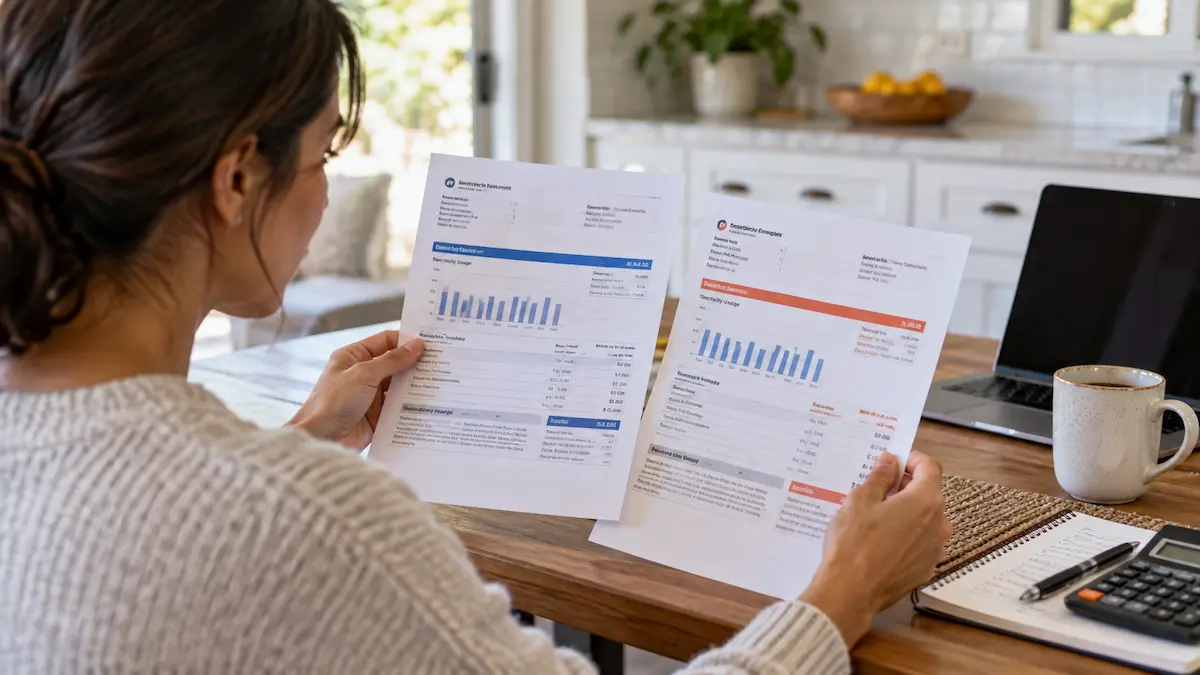
A usage graph can make two months look almost identical even when the exact kWh figures differ. Use the numerical kWh values printed on the bills rather than judging only from bar heights or rounded figures.
A modest increase in kWh combined with a higher electricity price or other charge can produce a noticeably larger increase in the final bill.
Calculate your effective cost per kWh as a clue
One quick comparison is to divide the bill's current-period electricity charges by the total kWh for that billing period. This produces an effective cost per kWh for comparison purposes.
Use this checklist when kWh is similar but the bill is higher
- Put the current and previous electric bills side by side.
- Compare the exact kWh values rather than only the usage graph.
- Compare the number of billing days.
- Compare electricity rates and per-kWh charge components.
- Compare fixed, service, delivery, and distribution charges.
- Check taxes, fees, riders, and surcharges.
- Check whether a previous credit disappeared or a new adjustment appeared.
- If you use time-of-use pricing, compare usage during each pricing period.
- Check whether the bill identifies estimated or actual meter readings.
- Contact the utility if a rate, adjustment, meter reading, or charge still cannot be explained.
Should you still check your appliances?
If total kWh truly stayed about the same, an appliance suddenly consuming large amounts of extra electricity is less likely to explain the higher dollar amount by itself. A major new electrical load would normally increase the home's measured electricity consumption.
However, if the kWh did increase more than you first realized, then household loads become relevant again. In that case, investigate heating and cooling, water heating, space heaters, EV charging, pool equipment, and other high-power or long-running devices.
When to contact your electric utility
Your utility is the appropriate source for account-specific explanations of its rates, tariff, meter information, and billing calculations.
- You cannot identify why the rate changed.
- A new fee, rider, surcharge, or adjustment is unclear.
- The meter reading does not appear to match the bill.
- You do not understand whether the reading was estimated or actual.
- Your rate plan appears to have changed.
- Supply or delivery charges changed unexpectedly.
- The total still does not make sense after comparing each line item.
What to do next
When your electric bill rises but kWh stays about the same, treat the bill itself as the primary diagnostic tool. Compare the rate, billing period, individual charges, pricing plan, credits, adjustments, and meter information before assuming something in your home is wasting electricity.
If the comparison shows that kWh actually increased significantly, switch the investigation back to household electricity use and identify what changed during the billing period.
Frequently asked questions
FAQ
Why is my electric bill higher if I used the same amount of electricity?
Your total bill can change even when kWh is similar because electricity rates and other bill components can change. Compare per-kWh charges, fixed and delivery charges, taxes and fees, credits, adjustments, billing days, and your rate plan.
Can electricity rates change even if my usage does not?
Yes. Electricity prices and rate structures vary by utility and location, and some plans also vary by season or time of use. Check your utility's current rate information and the rate schedule shown on your bill.
Can time-of-use pricing make my bill higher with the same kWh?
Yes. On a time-of-use or other time-variable rate, electricity can cost different amounts depending on when it is consumed. Similar total monthly kWh can therefore produce different costs if the timing of consumption changes.
Should I check appliances if my kWh usage stayed the same?
If the exact kWh truly stayed about the same, first investigate rates and billing components. A major increase in appliance electricity consumption would normally also increase measured kWh.
What should I ask the electric company about a higher bill?
Ask which line items changed between the two bills, whether your rate schedule changed, whether readings were actual or estimated, and whether any credits, adjustments, supply charges, delivery charges, fees, or other billing components changed.
Research
Sources
- Prices and Factors Affecting Prices— U.S. Energy Information Administration
- Electricity Glossary— U.S. Energy Information Administration
- Evaluating Your Utility Rate Options— U.S. Department of Energy
- Understanding Your Electricity Bills— U.S. Department of Energy
Keep reading